


Turning 40 does not create a single exercise rule for everyone. Your starting point depends more on current activity, health, symptoms, and goals than on a birthday. A useful routine combines movement you enjoy with manageable strength work and enough recovery.
This guide offers activity choices, a simple strength template, and two example weekly schedules. It is general information rather than a personalised programme. Adapt exercises to your needs, and get guidance when a health condition or symptom makes the next step uncertain.
Key takeaways
- Start with an amount of activity you can comfortably manage and build gradually.
- Include both aerobic movement and muscle-strengthening activity.
- Low impact does not mean every activity is suitable for every joint or condition.
- Progress one part of the routine at a time; there is no universal safe percentage increase.
- Stop for concerning symptoms rather than pushing through them.
In this guide
- Start from your current ability
- Choose an aerobic activity
- Build a simple strength routine
- Include mobility and balance
- Plan a manageable week
- Progress and recovery
- Questions and safety
Start from your current ability
Think about what you can do now: how long you can walk comfortably, whether you can rise from a chair, and what movements cause discomfort. Avoid comparing your first week with your best performance years ago.
For generally healthy adults, the CDC recommends at least 150 minutes of moderate-intensity aerobic activity a week and muscle strengthening on two days. Some activity is better than none, and the total can be spread across the week. This is a goal to work towards, not a requirement to meet on your first day.
If you have a chronic condition, ask a health professional about suitable activity and any modifications. If you have been inactive and want to start vigorous exercise, seek advice first. Age alone is not a reason to assume ordinary gentle movement needs medical clearance.
Warm up at an easier pace
Begin with a few minutes of comfortable walking, easy cycling, or gentle versions of the movements you will use. Gradually increase effort. At the end, ease back rather than abruptly stopping a demanding session. The amount of preparation should fit the activity and your needs.
Choose an aerobic activity

Aerobic activity makes you breathe harder and raises your heart rate. At moderate intensity, a useful guide is that you can talk but not comfortably sing. Adjust the pace rather than trying to match somebody else’s speed.
| Activity | Why you might choose it | What to consider |
|---|---|---|
| Walking | Accessible and easy to split into short outings | Choose suitable footwear, terrain, and a manageable pace |
| Stationary cycling | Seated activity with adjustable resistance | Seat fit, comfort, and getting on and off safely |
| Swimming or water exercise | An alternative when land-based activity is uncomfortable | Water confidence, supervision, pool access, and entry safety |
| Elliptical or rowing | Indoor options with adjustable effort | Balance, technique, and whether the movement suits you |
Walking
Start on a familiar route where you can shorten the outing if needed. You might begin with a few minutes, then repeat or extend it when comfortable. Hills and faster intervals are optional later additions, not requirements. Avoid adding hand weights simply to make a beginner walk harder.
Cycling and indoor equipment
Choose a comfortable setup and light resistance at first. A stationary bike reduces exposure to traffic but is not risk-free: stable mounting, correct adjustment, and a clear area still matter. Rowing technique deserves instruction if you are unfamiliar with the movement, especially if you have back symptoms.
Pool-based activity

Swimming, water walking, and suitable classes offer different ways to move. You do not need to swim fast laps to use a pool. Choose an option that fits your swimming ability and access needs, and follow pool safety rules. Water support does not make every stroke or movement comfortable for every shoulder, knee, or back.
For arthritis, CDC guidance emphasises joint-friendly choices, gradual starts, and attention to symptoms. A physical therapist can help choose movements and modifications. If pain or other symptoms are severe, seek advice rather than waiting for a programme to fix them.
Build a simple strength routine

Strength training can use body weight, bands, machines, or free weights. No single tool is automatically safest. Choose a version you can control, breathe normally through, and perform without sharp or worsening pain.
The following is a starter template, not a prescription. Begin with a small number of comfortable repetitions, stop before technique breaks down, and rest between exercises. If you are unsure about form or have a relevant condition, ask a qualified trainer or physical therapist for help.
| Movement | Possible beginner version | Technique reminder |
|---|---|---|
| Sit-to-stand | Rise from a stable chair, using support if needed | Use a controlled movement and a comfortable depth |
| Push | Wall push-up or another stable incline | Keep the surface secure and move without shoulder pain |
| Pull | Light resistance-band row | Use an appropriate secure anchor and inspect the band |
| Hip movement | Supported hip hinge or a comfortable bridge | Avoid forcing the back or range of motion |
| Calf movement | Supported heel raise | Keep a stable handhold available |
How to choose effort
Use a resistance that allows controlled repetitions without holding your breath or straining to complete the movement. You should feel the muscles working, but a beginner session does not need to end in exhaustion. Starting weights should be based on ability, not a fixed number for men or women.
How to increase the challenge
When a movement becomes consistently comfortable and controlled, change one variable: a few more repetitions, slightly more resistance, or a more challenging version. Do not increase everything together. There is no need to move from bands to dumbbells on a fixed calendar.
Spread challenging sessions for the same muscle groups across the week with recovery between them. Recovery needs vary with intensity, sleep, health, and how you feel. Consistency matters, but so does adjusting when fatigue or symptoms suggest the session is too demanding.
Include mobility and balance
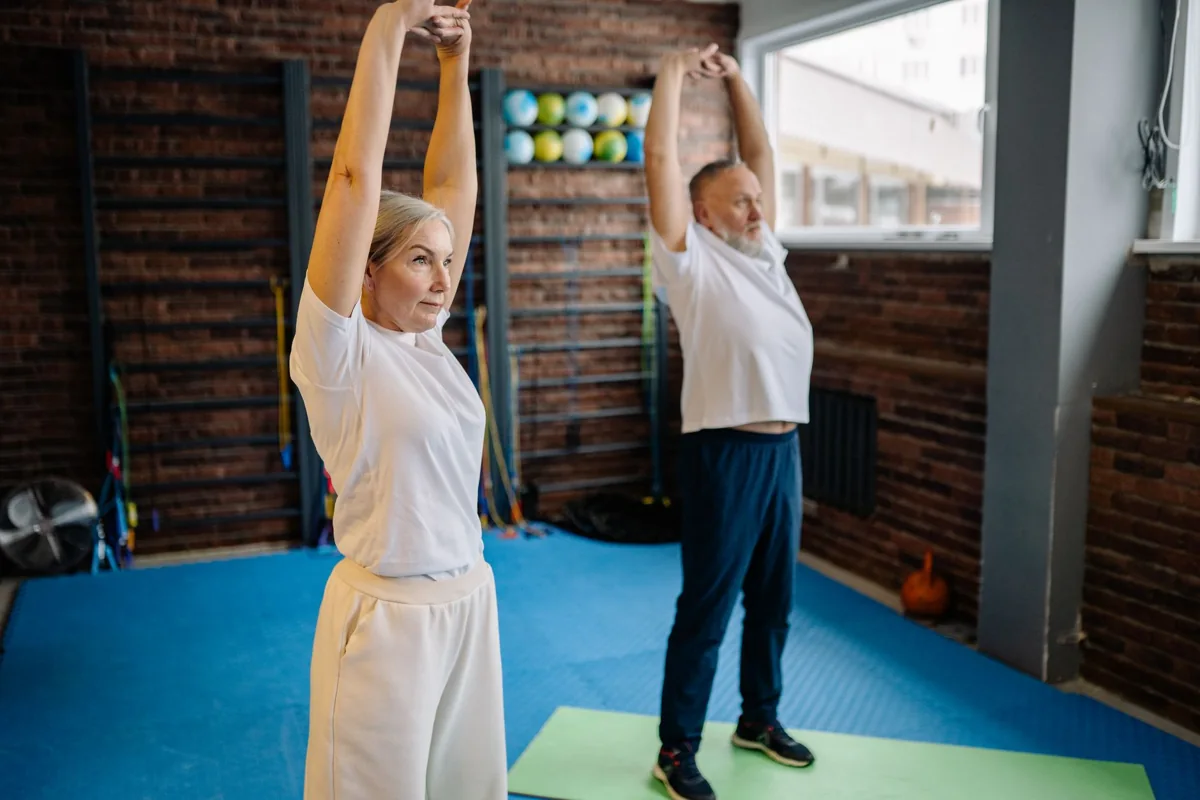
Mobility work can help you practise movements you need in daily life. Use slow, comfortable movements and do not force a stretch into pain. A gentle class, seated exercises, or brief movement breaks may be easier to repeat than a long flexibility routine.
- Move shoulders and ankles through a comfortable range.
- Use a supported stretch if it suits your needs; avoid bouncing or forcing the position.
- For balance practice, stay beside a stable support and use a level surface.
- Choose appropriate instruction for yoga, Pilates, or tai chi rather than assuming every class is suitable.
Do not practise balance with closed eyes or unstable equipment without appropriate guidance. If you have falls, dizziness, neurological symptoms, or significant mobility limitations, ask for tailored advice. Balance is worth considering, but it should not become an unnecessary fall risk.
Plan a manageable week
These examples show how to organise activity, not what everyone must complete. Shorten, rearrange, or replace sessions according to your ability and symptoms. Warm-up, mobility, and strength minutes should not automatically be counted as moderate aerobic activity.
Example A: easing back into activity
| Day | Possible activity |
|---|---|
| Monday | A short comfortable walk |
| Tuesday | A brief strength session with suitable modifications |
| Wednesday | Rest or easy movement |
| Thursday | Another short walk or a comfortable cycling session |
| Friday | A brief strength session |
| Saturday | An easy outing or enjoyable activity |
| Sunday | Rest or gentle movement as needed |
This starter week may fall below the adult aerobic guideline, which is fine while establishing an appropriate starting point. Add time gradually as it becomes comfortable rather than trying to make up the whole target in a single session.
Example B: an established moderate routine
| Day | Example activity |
|---|---|
| Monday | 30 minutes of moderate walking |
| Tuesday | 30 minutes of moderate cycling plus a strength session |
| Wednesday | Rest or easy mobility |
| Thursday | 30 minutes of moderate walking |
| Friday | A strength session; optional easy movement |
| Saturday | 30 minutes of moderate pool activity |
| Sunday | 30 minutes of moderate walking |
If all five aerobic sessions reach moderate intensity, this example adds up to 150 aerobic minutes, with two separate strength sessions. Those numbers do not guarantee the plan suits you. Swap activities and reduce the load when necessary.
Progress and recovery
Choose one manageable change at a time. Repeat a comfortable week before adding more if needed. A fixed “10 percent rule” cannot guarantee injury prevention, and turning 40 does not mean everyone needs the same recovery schedule.
- Track useful progress: A familiar walk feels easier, a daily task is more manageable, or a movement is more controlled.
- Respond to discomfort: Reduce or change a movement that causes sharp, worsening, or significant joint pain.
- Support recovery: Protect sleep, regular meals, and adequate fluids for your needs.
- Avoid all-or-nothing thinking: A shorter session or a rest day can be an appropriate adjustment.
- Keep it enjoyable: Choose activities you actually want to repeat.
Mild muscle soreness after unfamiliar activity can happen, but soreness is not proof of an effective workout. Severe symptoms, swelling, loss of function, or pain that does not improve should be assessed. Do not rely on a rigid waiting period when symptoms are concerning.
Questions and safety
Do I need to avoid running after 40?
Not simply because of age. Running may suit some people, while others prefer lower-impact activity. Consider current conditioning, symptoms, and gradual progression. There is no universal list of forbidden exercises based on turning 40.
Can I exercise with arthritis?
Often, suitable activity is encouraged, but choices and modifications depend on your condition. Discuss severe or persistent symptoms and consider physical-therapy guidance. Low impact is not a guarantee that every movement will be comfortable.
Do I need a gym or supplements?
No. Walking and appropriately chosen home exercises can be useful. A gym can offer equipment and instruction, but neither a membership nor a supplement stack is required to start. Nutrition needs should be considered individually.
When should I stop and seek help?
Stop exercise for chest pain or pressure, fainting, or severe or unusual shortness of breath and seek urgent medical help. Stop a movement that causes sharp pain or a sudden loss of function. Ask for assessment when symptoms are concerning rather than trying to push through them.
Your next step
Choose one comfortable aerobic activity and one appropriate strength option. Decide when you can realistically try them, and review how you feel afterwards. A routine that fits your current ability is a stronger starting point than an ambitious plan you cannot repeat.