

A multivitamin can help fill some nutrient gaps, but it is not automatically necessary for every adult. Start with your eating pattern, life stage, medicines, and any diagnosed deficiency. Choose a supplement for a defined need rather than for promises of extra energy, immunity, or disease prevention.
This guide explains how to read a label, avoid overlapping products, and decide what to discuss with a pharmacist or clinician. It uses US labeling references; recommendations and product formulations can differ by country.
The useful starting point: food, gaps, and individual needs

Vitamins and minerals matter, but a tablet cannot supply everything a varied diet provides. Food also contributes protein, fiber, essential fats, and other components. A supplement can be appropriate without being a substitute for meals.
- Varied intake and no identified gap: you may not need a daily multivitamin.
- Restricted intake, poor appetite, or difficulty meeting needs: review the pattern and whether food changes, a targeted supplement, or a multivitamin would help.
- Vegan eating, pregnancy planning, older age, or absorption problems: pay attention to specific nutrients rather than assuming any general bottle covers them.
- Symptoms or a diagnosed deficiency: get appropriate assessment and treatment rather than trying to fix the problem with an all-purpose product.
Jump to the label checks or download the supplement inventory and appointment checklist.
Do you need a multivitamin, a targeted supplement, or neither?

The NIH Office of Dietary Supplements notes that multivitamin/mineral products have no standard formulation. They may increase nutrient intake, but the amounts and ingredients vary. The first decision is therefore the need—not the brand.
Table tip: on small screens, swipe tables sideways to view every column.
| Your situation | A useful next step |
|---|---|
| You are unsure whether your diet has a gap | Review a few typical days of food, including fortified drinks and foods; avoid guessing from a marketing quiz |
| You avoid a food group or have a limited intake | Identify the nutrients affected and ask whether a targeted product is sufficient |
| A deficiency has been diagnosed | Follow the treatment dose, duration, and follow-up plan; a basic multi may not be enough |
| You already take several supplements | Inventory the combined nutrients before adding another bottle |
A multivitamin is not a diagnostic test, and a high price does not establish that you need it. If you take a medically prescribed product, do not stop or replace it because a general guide recommends a simpler routine.
Read the Supplement Facts panel before the front label

- Check the serving. Amounts may apply to two tablets, several capsules, or multiple gummies—not one piece.
- Read actual amounts and units. Milligrams (mg) and micrograms (mcg or µg) are different: 1mg equals 1,000mcg.
- Check the nutrient form when it matters. For example, folate labels may use dietary folate equivalents (DFE); that is not a second nutrient to add to the folic acid amount in parentheses.
- Look for omissions and extras. Calcium, magnesium, iodine, iron, or choline may be absent or present in small amounts; herbal blends and stimulants may add complexity.
- Read directions, cautions, and allergens. “For men,” “50+,” “natural,” or “whole food” is not a complete description of the formulation.
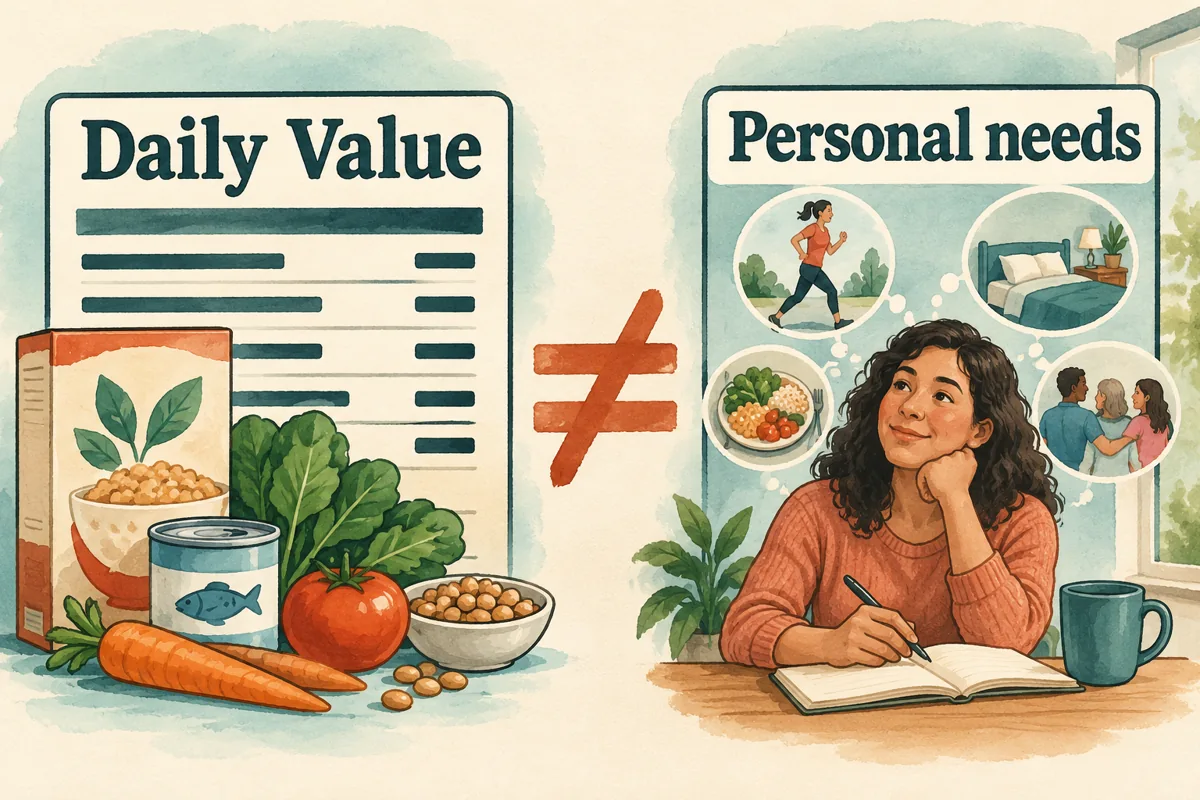
Daily Value is not a personalized dose or an upper safe limit. The FDA labeling reference helps compare products, but age, pregnancy, and other individual factors can change nutrient needs. A product labeled 100% DV is not automatically the right amount for you.
The following are selected US label Daily Values for adults and children age four and older—not instructions for how much supplement to take.
| Nutrient | US label Daily Value | Important interpretation |
|---|---|---|
| Vitamin D | 20mcg | Do not confuse the label reference with your age-specific recommendation or a treatment dose |
| Vitamin B12 | 2.4mcg | Absorption problems may require a different approach |
| Folate | 400mcg DFE | DFE and folic acid amounts are not interchangeable numbers |
| Iron | 18mg | Needs vary; an iron-containing multi is not appropriate for everyone |
| Calcium | 1,300mg | A small tablet may provide only a fraction; include food intake in the review |
Do not take extra tablets to make every nutrient reach 100% on paper. That can raise the other nutrients unnecessarily. Use the label as a comparison tool alongside an appropriate recommendation.
Add up overlapping products before adding a new one
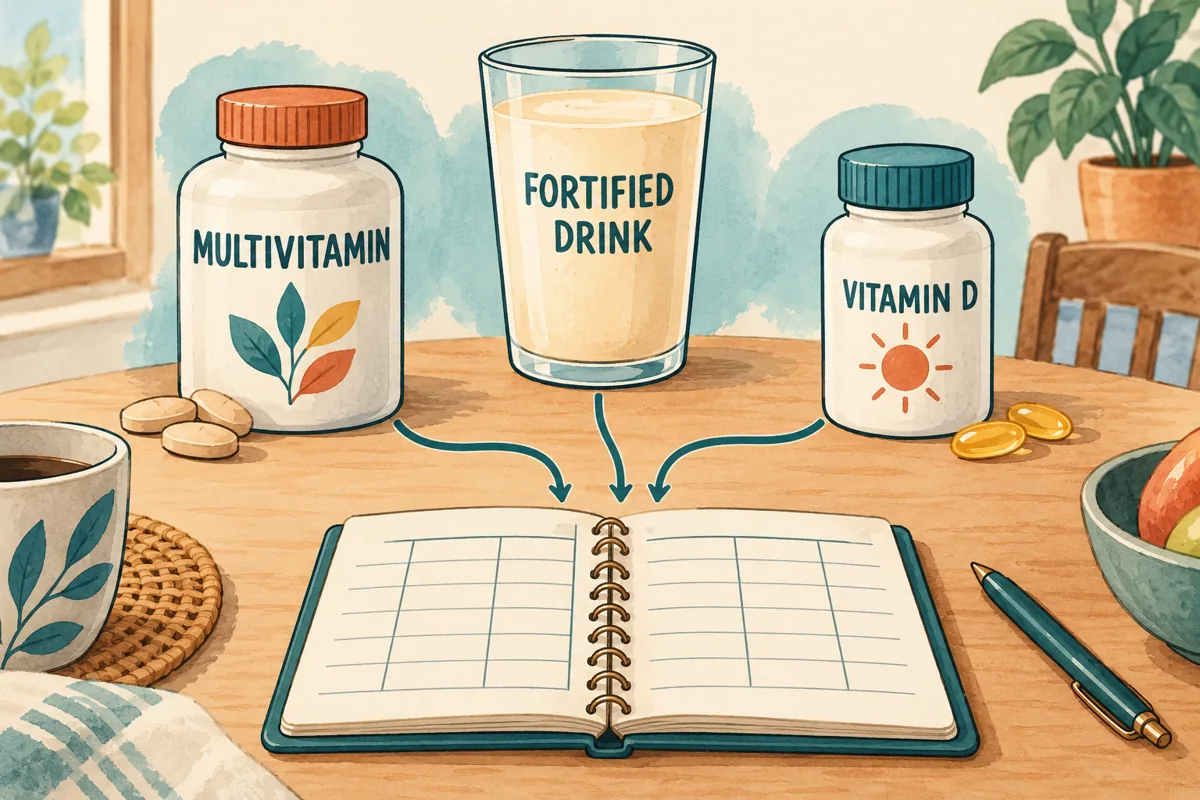
Common overlaps include a multivitamin plus a separate vitamin D product, a B-complex or hair-and-nail supplement, and fortified powders, cereals, or drinks. Check the amounts for the portions you actually consume, not just the number of bottles.
Illustrative calculation: if one product contributes 10mcg vitamin D and another contributes 25mcg, the combined amount from those two products is 35mcg. That is arithmetic, not a recommended dose or a safety judgment; food and other sources still need consideration.
Use upper-limit information for the specific nutrient and your circumstances rather than treating all vitamins the same. Limits may apply to total intake or to certain supplemental forms, depending on the nutrient. A clinician may deliberately prescribe a different short-term treatment regimen.
If you also use protein powder, check whether the selected version has added vitamins and minerals. A sports, energy, or meal product can overlap even when its front label does not look like a vitamin bottle.
Nutrients that deserve a specific check
Vitamin B12: check reliable sources and absorption

The NIH B12 guide explains that people eating little or no animal food may need fortified foods or supplements to obtain enough B12. Some older adults and people with absorption-related conditions or certain medicines also need particular attention. Unfortified plant foods are not a reliable substitute for a planned B12 source.
Do not assume a more expensive “methylated” bottle is automatically better. The needed amount and method depend on the situation; treatment of a diagnosed deficiency is different from routine dietary supplementation.
Vitamin D: a normal function is not a treatment promise
Vitamin D supports calcium absorption and other normal functions. The NIH vitamin D guide distinguishes recommended intake from high-dose treatment and warns that excessive supplementation can be harmful. That does not justify a routine high-dose add-on for everyone with an indoor job.
Do not infer that taking more will prevent depression, heart disease, infections, or weight gain. Association between low blood levels and a condition is not proof that a supplement treats or prevents it. Ask whether a dietary review, risk assessment, or test is actually indicated.
Folate and pregnancy planning: get the right guidance early
If you could become pregnant, CDC advises 400mcg folic acid daily, alongside a varied diet. Pregnancy-related needs and some medical histories require individual prenatal advice; a generic adult multivitamin is not automatically a suitable prenatal product.
Common MTHFR variants are not a reason to avoid folic acid. CDC explains that people with these variants can process it. Do not substitute a marketing claim about “activated” folate for pregnancy-care guidance.
Iron: choose for the need, not the highest number
The NIH iron guide describes different needs across life stages and the risks of excess. Menstrual losses, pregnancy, diagnosed deficiency, and conditions that cause iron accumulation can change the decision. Avoid adding high-dose iron simply because you feel tired.
Calcium, magnesium, iodine, and other minerals also deserve a formulation check. A large “complete” claim does not mean the product meets every need, and trying to make one pill do everything is not always practical.

Life-stage labels are a starting point. Older-adult products, prenatal products, and ordinary adult multis differ, but so do products within each category. Confirm the contents and appropriateness rather than assuming all bottles with the same demographic wording are equivalent.
Interactions and higher-dose pitfalls to check

- Warfarin: discuss vitamin K changes with the prescribing team. The aim is not to eliminate all vitamin K foods or change treatment yourself.
- Medicines affected by minerals: iron, calcium, and other ingredients can affect some medicines. Ask a pharmacist about your exact drugs, labels, and timing rather than applying one spacing rule to everything.
- Pregnancy and vitamin A: check preformed vitamin A and the entire formulation with your maternity-care professional. More is not automatically better.
- Biotin and blood tests: disclose hair-and-nail products and other supplements before testing. Do not decide a stopping interval without the laboratory or clinician’s advice.
The NIH multivitamin guidance covers important cautions, and FDA warns that biotin can interfere with some laboratory tests. Bring all products to the review, including occasional supplements and nonprescription medicines.

Water-soluble does not mean harmless at any dose. For example, the NIH B6 guide warns that high supplemental intakes over time can damage nerves. Do not assume excess B vitamins are simply flushed out with no possible harm.
Also check duplicate high-dose products, added herbs, and ingredients intended for “energy” or “metabolism.” Avoid treating a multivitamin as a way to make a very restrictive diet safe. Kidney disease, absorption disorders, recent surgery, and other medical situations may need a specific plan.
Choose a product you can use appropriately

Do not choose by the front of the bottle alone. Packaging can communicate a target audience, but it cannot show the complete serving, nutrient amounts, interactions, or whether a formula is right for you. The packaging example above is not a current product ranking or an endorsement.

Check whether you can swallow the tablets, whether the full serving is practical, and whether the product fits your dietary preferences and allergies. Gummies may have different nutrient profiles and servings from tablets; do not assume either format is more complete or effective.
Follow the directions and individual advice. Taking a product with food may improve tolerance, and some nutrients are absorbed better with a meal containing fat. There is no universal best clock time for every multivitamin. Do not split, crush, double, or alter a product unless its instructions or a pharmacist support that change.

Verify a claimed quality program through its own directory. The USP Verified Mark, for example, addresses defined identity, content, manufacturing, and other quality criteria. That is different from proving a product prevents disease, is necessary, or is suitable for your medicines.
In the US, dietary supplements are not approved by FDA for safety and effectiveness before sale. Treat a sweeping “FDA-approved vitamin” claim cautiously, and distinguish supplements from prescription products.

Store supplements securely away from children and follow the storage instructions. Iron-containing products can be particularly dangerous in an accidental ingestion; gummies are not treats. If a child may have swallowed an unsafe amount, contact local poison-control or emergency services promptly rather than waiting for symptoms.
Do not use symptoms or prevention promises as a diagnosis
Fatigue, tingling, hair changes, poor concentration, or muscle symptoms can have many causes. They do not identify a vitamin deficiency on their own, and feeling better after starting a supplement does not prove which ingredient helped. Persistent or concerning symptoms deserve appropriate assessment.
Testing should follow the clinical question, history, examination, and risk factors. There is no universal vitamin panel or retesting interval required for every healthy adult. If a deficiency is diagnosed, ask which test or other follow-up will show whether treatment is working.
For prevention of cardiovascular disease and cancer in generally healthy, nonpregnant adults without known deficiencies, the USPSTF finds evidence insufficient to recommend for or against multivitamins and recommends against beta-carotene or vitamin E supplements for that purpose. This is not a statement against treating an actual deficiency, and it does not apply to every medical or pregnancy situation.
Multivitamin research varies by population, formulation, and outcome. It does not justify a general promise that one bottle will fix fatigue, prevent chronic disease, or protect everyone’s memory.
Bring a useful inventory to the conversation

Download the two-page supplement inventory and appointment checklist. Record the exact product, full serving, nutrients, reason for use, medicines, and any concerns. Include fortified foods and drinks when they contribute meaningful overlapping amounts.
- What specific need are we addressing?
- Could food or a single-nutrient product meet it more simply?
- Do any products overlap or interact with my medicines or tests?
- Is testing needed, and what would the result change?
- What dose, duration, and follow-up apply to me?
Will a multivitamin give me more energy?
Not reliably if you already have adequate nutrient intake. Fatigue deserves a review of its possible causes rather than an assumption that a stronger multi is the answer.
Does a multivitamin replace omega-3 foods or products?
No. Omega-3 fatty acids are not vitamins, and the amount or presence in a combination product varies. Whether a separate supplement is appropriate is a different decision—not a reason to add one automatically.
Must I buy methylated or “natural” forms?
No general premium is justified by those words alone. The relevant form and amount depend on the nutrient and situation. Read the evidence and ask about a specific need rather than treating all “activated” ingredients as superior.
How long should I wait for results?
There is no universal timeline. A diagnosed deficiency has a treatment and follow-up plan; routine use may produce no noticeable sensation. Do not keep increasing the dose or delay assessment while waiting for a promised improvement.
Bottom line: identify the need, check the complete label and combined intake, and choose an appropriate plan—not simply the longest nutrient list.
General education, not an individual supplement prescription or diagnosis. The additional images are AI-generated visual aids; generic labels are illustrative, not real product panels. Sources checked 19 October 2026.